01 Summer · Hiking and trekking
Hikingand trekking.
A few hours on the trail or several days hut to hut: the pack, the boots and what you carry all change. We help you choose the kit for the way you walk.
i In short
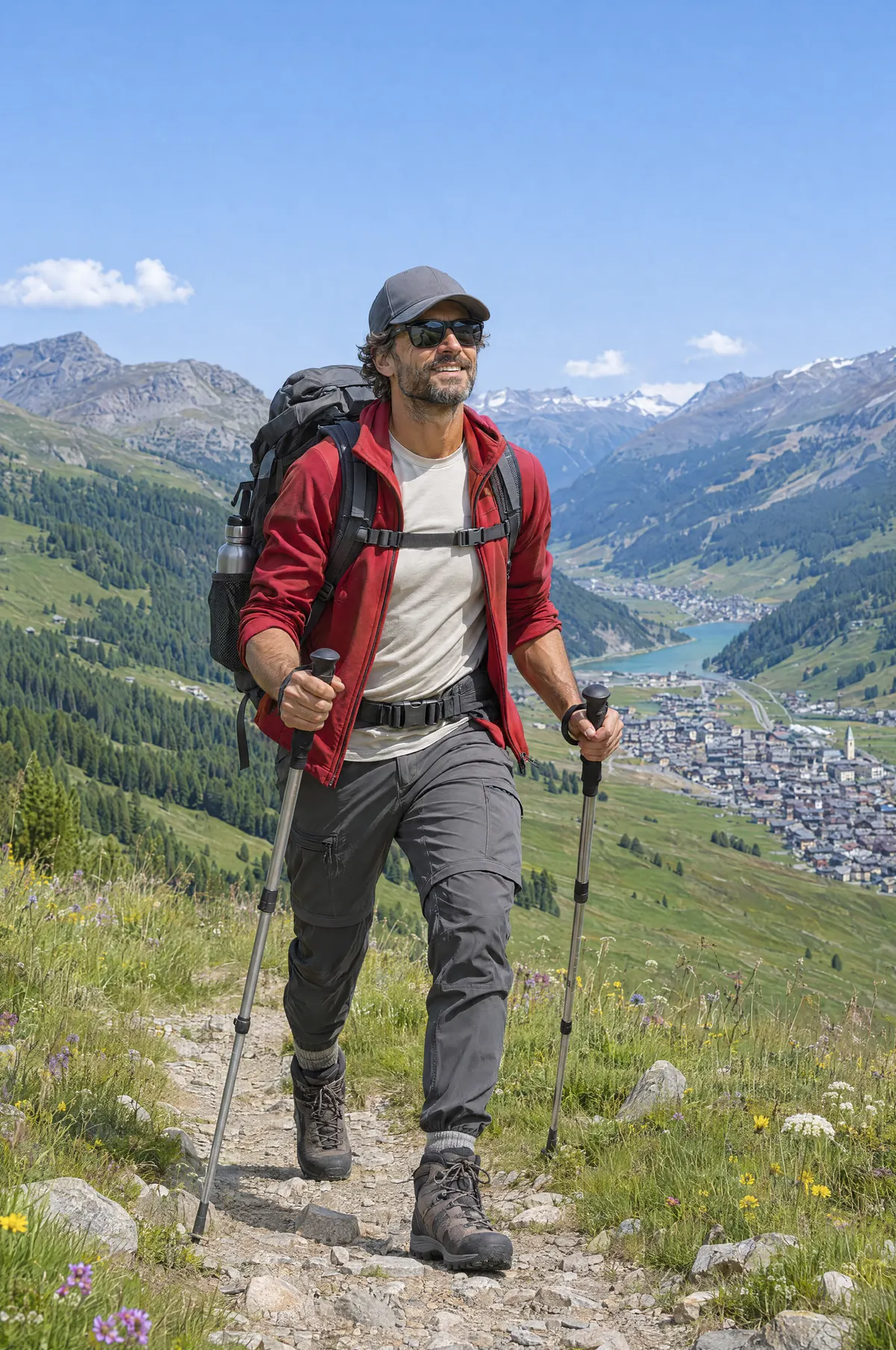
Sport Extreme, at Via Prestefan 14 in Livigno, sells hiking and trekking gear and clothing: boots from Scarpa, Meindl, Lowa and Salewa, packs from Deuter and Osprey, poles from Leki and Black Diamond, and clothing from Karpos, Odlo, Salewa, Haglöfs and Mammut. Hiking is done in a day; trekking lasts several days, with nights in huts or bivouacs. Its advisors help you choose based on trip length, terrain and pack.
A The kit, piece by piece
What matters,
piece by piece.
Scroll: for every piece of kit we tell you what to look for in this sport, and which brands you'll find in store.
Scroll ↓
Cap
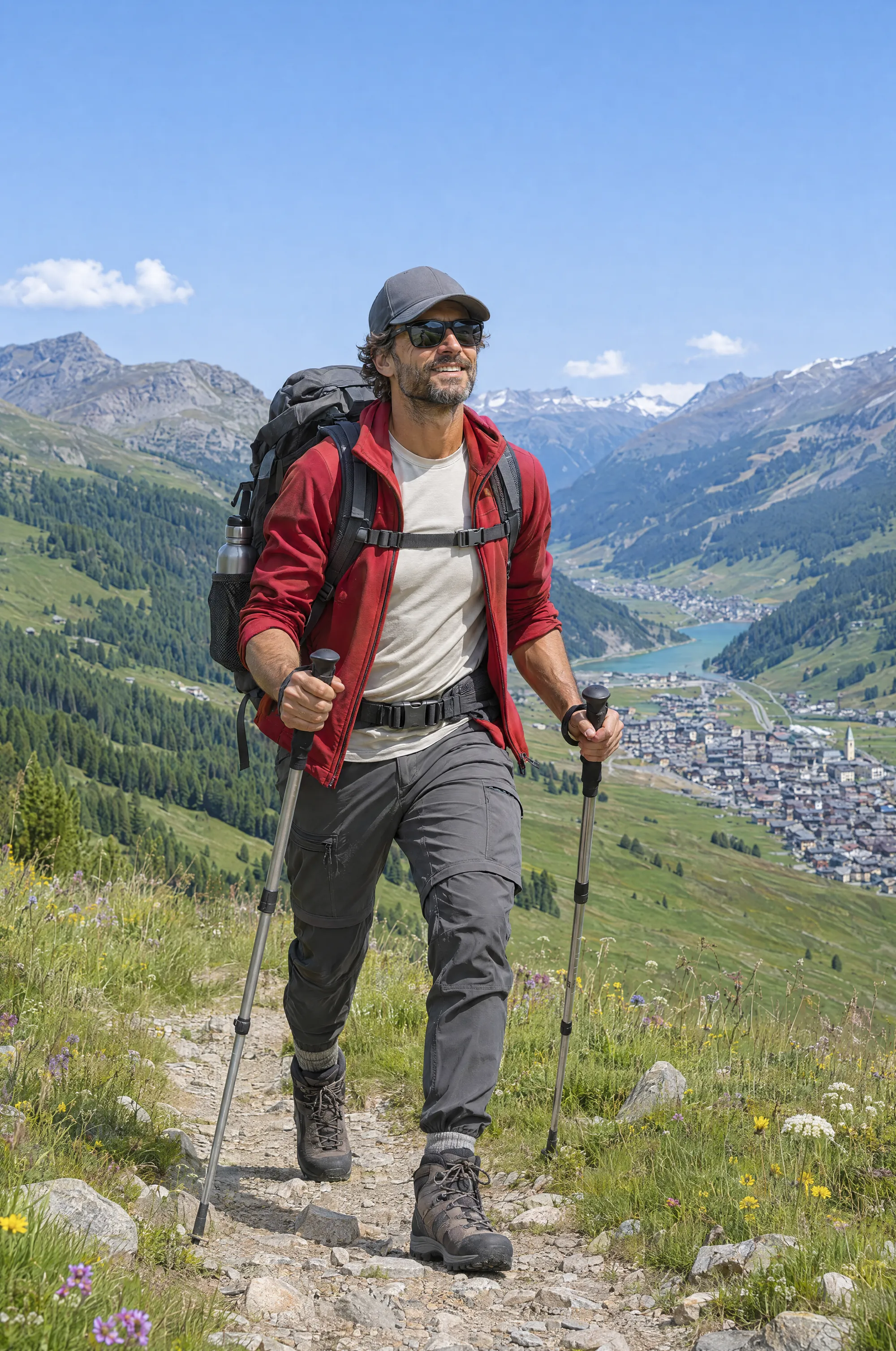
The peak shades your eyes and face: UV levels rise by about 10% for every 1,000 m of altitude. Choose a technical fabric that dries quickly.
Sunglasses
Mountain sun calls for category 3 lenses with UV 400 protection; category 4 is for snow and glaciers, and not for driving. A wraparound frame also blocks light from the side.
Jacket
A light softshell blocks the wind and breathes while you climb. Keep a waterproof shell with taped seams in your pack too: storms build quickly up high.
Brands: Salewa · Karpos · Haglöfs · Mammut
Technical top
Merino or synthetic next to your skin, never cotton: it moves sweat away and doesn't chill you at the first windy stop.
Brands: Odlo · Karpos · Salewa
Backpack
A day hike needs 20–30 litres; trekking hut to hut takes about 40. The padded hip belt carries the weight on your hips, and the sternum strap keeps the shoulder straps in place.
Brands: Deuter · Osprey
Trousers
Stretch fabric and articulated knees let you step up onto rock. Convertible models zip off above the knee when it gets hot.
Brands: Salewa · Karpos · Haglöfs · Mammut
Poles
On flat ground your elbow should bend at about 90°: shorten them for climbs, lengthen them for descents. They take some of the load off your knees, especially with a full pack.
Brands: Leki · Black Diamond
Socks
Merino wool or synthetic fibres, cushioned at heel and toe, with flat seams. Cotton holds sweat, softens the skin and causes blisters.
Boots
Multi-day treks call for a high-cut, structured boot with a stiff sole that won't flex under a heavy pack. For day hikes a mid boot is often enough; either way, deep lugs grip dirt and mud.
Brands: Scarpa · Meindl · Lowa · Salewa
All of this,
at Via Prestefan 14.
Come and try it on: we put together the right kit for you, piece by piece.
Call the shop→B Summer
How to choose
- Hiking or trekkingHiking is a day out with no night away; trekking runs over days, with a 40 L pack and high boots.
Hiking is done in a day, from a few hours to a full day, with no overnight stay. Trekking lasts several days, with nights in huts or bivouacs, in wilder terrain, and needs more fitness. For trekking you need a pack of 40 litres or more and a structured, high-cut boot.
- Low, mid or high-cutLow-cut for good paths, mid for scree, high-cut for heavy packs and multi-day treks.
Low-cut shoes are light and suit good paths and short outings. Mid boots support the ankle on scree and broken ground. Stiffer high-cut boots are for heavy packs and multi-day treks.
- Sole and membraneDeep lugs grip dirt and mud; a membrane keeps you dry but breathes less in the heat.
Deep, widely spaced lugs bite into dirt and mud and shed it as you walk; a stiffer sole tires your feet less on boulder fields. A waterproof membrane keeps your feet dry in rain, wet grass and snow patches, but breathes less in hot weather.
- Litres and back length20–30 L for a day, about 40 hut to hut: choose by torso length, not by height.
20–30 litres is enough for a day, about 40 hut to hut, and 50 or more with a tent and stove. Choose a pack by torso length, from the bony vertebra at the base of your neck to the top of your hip bones, not by height.
D In Livigno
Where to walk in Livigno
The tourist office counts more than 1,500 km of trails around the valley. To start, there's the lakeside walk, 2.4 km and almost flat, in about 45 minutes; Val Federia climbs 6 km from Ponte Calcheira, at 1,850 m, to Alpe Federia, at 2,210 m. For treks, you'll find huts and baitel along the trails: small restored cabins with a wood-fired stove, a table and places to sleep.
E Quick advice
How long will you be out?
Our advice
F In store
We listen first
We ask where you walk, for how many days and with what pack, then let you try boots from Scarpa, Meindl, Lowa and Salewa and packs from Deuter and Osprey, adjusted to your back. The advice is for your feet, whatever the brand. And in Livigno's duty-free zone, there's no VAT.
G Frequently asked questions
Good to
know.
What's the difference between hiking and trekking?
Hiking is a day out: from a few hours to a full day, with no night away. Trekking lasts several days, with nights in huts, bivouacs or a tent, often in wilder terrain, and it takes more fitness. That's why trekking calls for a pack of 40 litres or more and a structured, high-cut boot.
Should I buy hiking shoes or boots?
Whether you need hiking shoes or boots depends on the terrain and how much you carry. On good paths, low-cut shoes are lighter and more comfortable; on scree, rough high-level trails or with a heavy pack, a mid or high-cut boot gives your ankle more support. If your ankles tend to roll, a mid boot is often the better choice even on easy ground.
Are waterproof hiking shoes too hot for summer?
A hiking shoe with a waterproof membrane is a little warmer and breathes less than an unlined one. In return it keeps your feet dry in rain, dewy morning grass and the snow patches you still find up high in early summer. If you mostly hike in warm, dry weather, an unlined shoe stays cooler and dries faster.
How much room should hiking boots have at the toe?
Hiking boots need about a finger's width of room in front of your toes, with the heel held firmly. Your foot slides forward on descents, so if your toes hit the front, the size is too small. Try them on with your hiking socks, ideally in the afternoon, when your feet are slightly swollen.
What backpack do I need for a multi-day trek?
For a multi-day trek staying in mountain huts, you need a backpack of about 40 litres. If you're camping and cooking for yourself, with a sleeping bag, mat and stove, you need 50 litres or more. Either way, the back length must fit and the hip belt should carry the weight.
Come and
see us.
Every day 09:00–12:30 · 14:00–19:30
Via Prestefan 14 · 23041 Livigno · 1.816 m