02 Running · Trail running
Trailrunning.
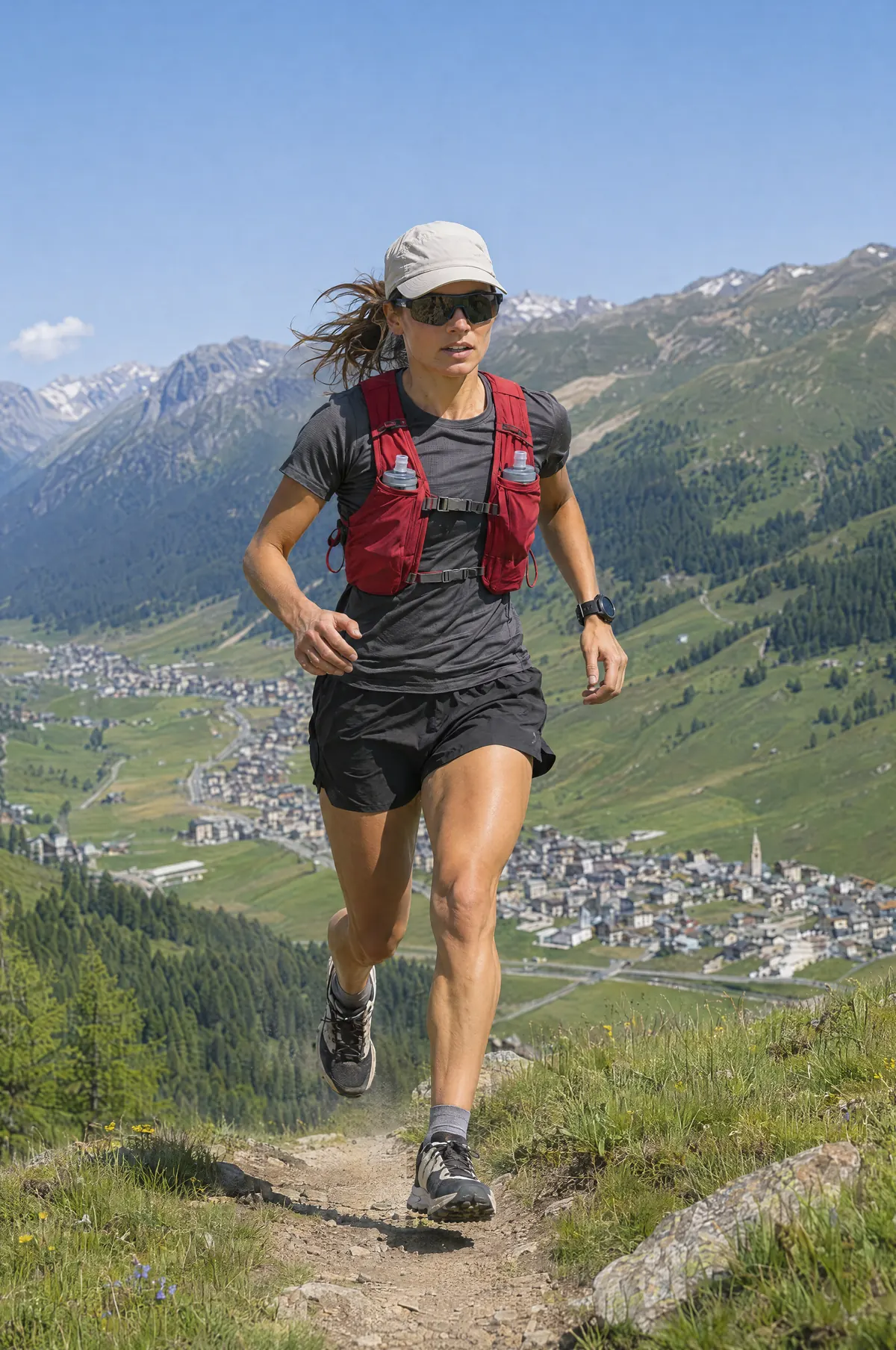
Gravel tracks, pastures, boulder fields: up high the ground changes every kilometre. We help you find a trail shoe with the grip and cushioning that suit you, and a vest to carry water and a shell.
i In short
Sport Extreme, at Via Prestefan 14 in Livigno, sells trail running shoes from Salomon, Altra, Asics, Saucony and Nike, plus running vests and clothing for the mountains. Its advisors help you choose lugs, cushioning and fit to match your terrain, distances and running style.
A The kit, piece by piece
What matters,
piece by piece.
Scroll: for every piece of kit we tell you what to look for in this sport, and which brands you'll find in store.
Scroll ↓
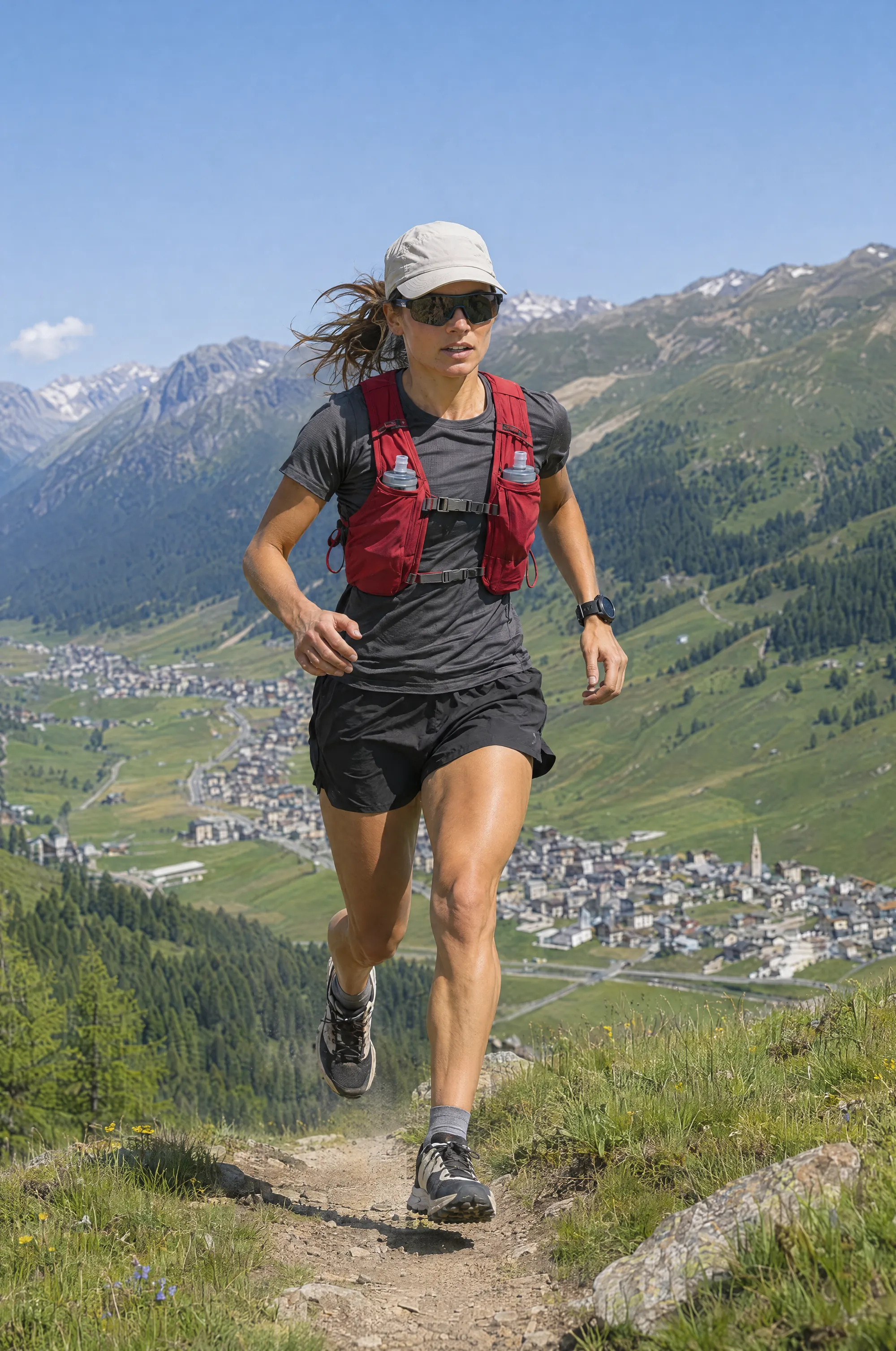
Cap
Light and perforated: it shades you from the high-altitude sun and stops sweat before it reaches your eyes.
Sunglasses
A light wraparound frame that doesn't bounce on descents. Category 2 or 3 lenses: dark enough for sunny ridges, not too dark for the woods.
Top
Light synthetic or merino blend that dries as you run. Flat seams where the vest straps sit, so nothing rubs.
Brands: Salomon · Odlo · Karpos
Running vest
It fits close like a top, so it doesn't bounce: soft flasks in front, shell and warm layer behind. For a few hours out, 5–8 litres is enough.
Brands: Salomon
Shorts
Light, with an inner brief and waist pockets for gels and phone. A short cut leaves your stride free on steep climbs.
Brands: Salomon · Odlo
GPS watch
It tracks distance, climb and altitude. With a route loaded you can find the trail again when fog hides the waymarks; check the battery lasts longer than your run.
Socks
Thin synthetic socks with no seams over the toes: your foot slides less inside the shoe and blisters come later, even on long descents.
Trail shoes
Deep lugs for dirt and grass, sticky rubber for wet rock and a toe bumper against stones. On descents the fit must hold your heel and midfoot firmly.
Brands: Salomon · Altra · Asics · Saucony · Nike
All of this,
at Via Prestefan 14.
Come and try it on: we put together the right kit for you, piece by piece.
Call the shop→B Summer
How to choose
- Lugs3–4 mm lugs for dry, hard-packed trails; 5 mm and up for mud, wet grass and soft ground.
Lugs of 3–4 mm work on dry, hard-packed trails; 5 mm and up grip in mud, wet grass and soft ground. Widely spaced lugs stop mud from clogging the sole.
- Rubber and protectionSticky rubber for wet rock, a rock plate against stones and a bumper for your toes.
On wet rock, sticky rubber is what counts. A rock plate in the midsole protects the sole of your foot from sharp stones; a rubber toe bumper protects your toes when you catch a rock.
- Hold on descentsOn descents keep heel and midfoot firm and toes free: no black toenails.
Your foot slides forward on descents: heel and midfoot must stay put, with room for your toes. Lacing that closes the midfoot well prevents black toenails after long descents.
- Vest and supplies5–8 litres for a few hours; 10–12 for long days and mandatory kit.
For a few hours, a 5–8 litre vest with two soft flasks is enough; long days and races with mandatory kit call for 10–12 litres. It should fit close without squeezing your chest when you breathe hard.
D In Livigno
Trails to run
The trails around Livigno start from the valley floor at 1,816 m and climb towards ridges and alpine pastures. Trail no. 190, the Tröi da li Téa, contours along the western slope: 7 km with about 200 m of climb, past the tée, the old wooden houses. In July the Stralivigno, a mountain half marathon, packs 21 km and about 450 m of climb between 1,800 and 2,000 m.
E Quick advice
What terrain will you be on?
Our advice
F In store
Tell us where you run
We ask what trails you run, how far and how often, then let you try several models from Salomon, Altra, Asics, Saucony and Nike. The advice is for your feet and your stride, whatever the brand. And in Livigno's duty-free zone, there's no VAT.
G Frequently asked questions
Good to
know.
Do I need waterproof trail shoes?
Trail shoes with a waterproof membrane are useful in cold mud, snow and rain, and early or late in the season. In summer they run warmer, and water that gets in over the collar struggles to get out. For the warm months, many runners prefer a breathable upper that dries quickly.
What should I carry on a mountain run?
On a mountain run, carry water, a light windproof or waterproof jacket and a warm layer, even when the valley is sunny. Mountain weather changes fast and it's colder at the top. A running vest keeps everything steady as you move, and a charged phone is there for emergencies.
What size running vest do I need?
For a few hours out, a 5–8 litre vest holds two soft flasks, a light shell and some food. Long days and races with mandatory kit, such as a shell, warm layer, survival blanket and head torch, usually call for 10–12 litres. More than the litres, what matters is a close fit that doesn't bounce.
Do I need poles for trail running?
On long, steep climbs, folding poles let your arms help you push and spare your legs on the way down; when you don't need them, they stow in your vest. On short, runnable routes they're often unnecessary. In races, check the rules: some events ban them.
Come and
see us.
Every day 09:00–12:30 · 14:00–19:30
Via Prestefan 14 · 23041 Livigno · 1.816 m